
How Much Does It Cost to Run a Deep Freezer in Nigeria?


- 1The short answer
- 2What decides the cost
- 3Step 1: Read the label on your freezer
- 4Step 2: Find your real tariff
- 5Step 3: Estimate the duty cycle
- 6A worked example
- 7How to measure the real cost
- 8Case study: a shop with two freezers
- 9Grid, generator or solar: how they compare
- 10Eight ways to lower the running cost
- 11Five mistakes I see in cost estimates
- 12Quick checklist
- 13Questions people ask
- How much does a deep freezer cost per month?
- Does a full freezer use less power?
- Is it cheaper to run one big freezer or two small ones?
- Can I run a deep freezer on an inverter?
- Should I turn the freezer off when the shop is closed?
- 14Continue reading
- The cost depends on watts, compressor run time and your tariff
- A measured kWh figure beats any calculated one
- Simple habits like airflow, defrosting and fewer lid openings can lower the bill
- Grid, generator and solar each have a different cost per unit
A deep freezer looks cheap to run until the electricity bill arrives. Then the same question comes up: where did all those units go?
In this guide I explain how I would work out the real cost, step by step. You will read your freezer label, find your true tariff, and end with a monthly figure you can trust.
I also include a case study, two comparison tables and eight ways to cut the bill. Every example number is made up for teaching, so swap in your own.
The short answer
There is no single price. A deep freezer costs different amounts in different shops.
Three things change the result: how much power it draws, how long the compressor runs, and what you pay per unit.
Your bill or prepaid token counts power in kilowatt-hours (kWh), often called units. This is the formula I use every time:
Daily kWh = watts × hours plugged in × duty cycle ÷ 1,000
Daily cost = daily kWh × tariff per kWh
Duty cycle is the share of time the compressor is actually running. A freezer plugged in for 24 hours does not pull full power all day.
The compressor switches on, cools the box, then switches off.
Here is a quick picture. A freezer rated at 150 watts, running half the time, uses about 1.8 kWh a day. At an example tariff of ₦150 per kWh, that is about ₦270 a day.
Quick tip: Skip the guessing where you can. A cheap plug-in energy meter gives you the real daily kWh in one day.
What decides the cost
Seven things move the number up or down. Knowing them helps you see where your own money is going.
- Rated power. Bigger freezers usually carry a higher wattage on the label. A 100-litre box and a 500-litre box do not cost the same to run.
- Duty cycle. The longer the compressor runs, the more units you use. Heat, frost and a weak door seal all make it run longer.
- Room temperature. A freezer in a hot, closed shop works harder than one in a cool, ventilated spot.
- Lid openings. Each time you open the lid, warm air gets in. The compressor then has to pull that heat out again.
- How full it is. A packed freezer holds cold well. A nearly empty one warms up quickly when the lid opens.
- Condition. Thick ice, a loose seal or dusty coils make the compressor work harder than it should.
- Your tariff. The same freezer costs more on a higher rate. If you use a generator, fuel changes the picture again.
Step 1: Read the label on your freezer
Every freezer has a rating label. You will usually find it at the back, on the side, or inside near the top edge.
Look for the voltage, the power in watts (W), and sometimes the current in amps (A). Some labels also show energy use in kWh per 24 hours or per year.
If you only see volts and amps, multiply them to get watts. For example, 230 volts × 0.65 amps gives about 150 watts. Use the voltage printed on your label.
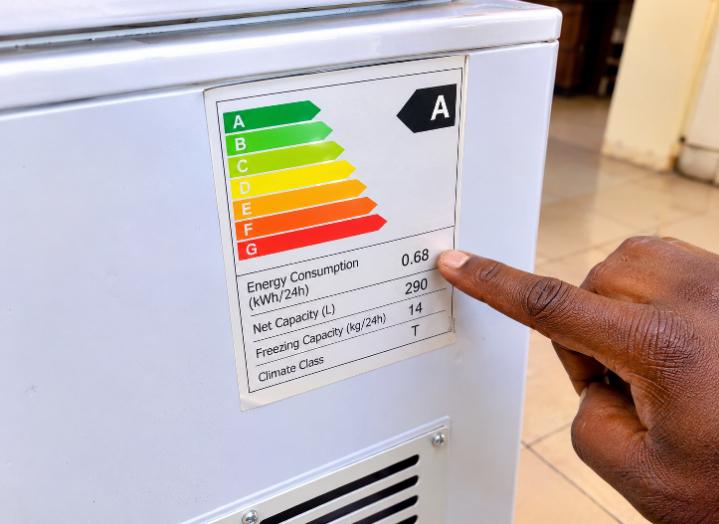 Find the rating label at the back or inside the freezer, then copy the watts and kWh figures.
One warning here. The watts on the label show the power while the compressor is running. It is not the average over the day, so do not multiply it by 24 hours and stop.
If your label shows kWh per 24 hours, that figure comes from a test room. A hot shop with a busy lid will usually give you a higher number.
Step 2: Find your real tariff
Do not trust a rate you heard from a friend. Your own receipt tells you the truth.
Take your last prepaid token receipt. Divide the naira you paid by the units you received. The answer is your real cost per unit, including any charges taken out.
If you pay a monthly bill instead, divide the total amount by the kWh used. Do this for two or three months, because the figure can change.
Using a generator? Then your cost per unit comes from fuel, not from the meter. I cover that in the comparison table later in this guide.
Step 3: Estimate the duty cycle
Duty cycle is the hardest number to guess. It changes with the weather, your shop and how you use the freezer.
Many people start with a guess somewhere between 40% and 60%. Treat that as a starting point only. A hot room or a frosty freezer can push it higher.
Here is how I think about it. If the compressor sounds like it is running most of the day, your duty cycle is probably high. Something is making it work too hard.
A worked example
Let me put numbers on it. Say your freezer is rated at 150 watts and stays plugged in for 24 hours.
I assume the compressor runs half the time, and the tariff is ₦150 per kWh.
- Daily energy: 150 × 24 × 0.5 ÷ 1,000 = 1.8 kWh
- Daily cost: 1.8 × 150 = ₦270
- Monthly cost (30 days): 54 kWh × 150 = ₦8,100
- Yearly cost: 657 kWh × 150 = ₦98,550
That yearly number surprises many people. A freezer that "uses a little" adds up to a real expense over twelve months.
The next table shows how much the duty cycle and tariff change the monthly cost of the same 150-watt freezer. The rates are examples, not current tariffs.
| Duty cycle | At ₦100 per kWh | At ₦150 per kWh | At ₦200 per kWh |
|---|---|---|---|
| 40% | ₦4,320 | ₦6,480 | ₦8,640 |
| 50% | ₦5,400 | ₦8,100 | ₦10,800 |
| 60% | ₦6,480 | ₦9,720 | ₦12,960 |
Look at the corners of that table. The cheapest case costs half as much as the dearest one. Both are the same freezer.
Size matters too. This second table compares three example freezers at a 50% duty cycle and ₦150 per kWh. The watts are examples, not specific models.
| Freezer size | Label watts | Daily kWh | Monthly kWh | Monthly cost |
|---|---|---|---|---|
| Small | 100 W | 1.2 | 36 | ₦5,400 |
| Medium | 150 W | 1.8 | 54 | ₦8,100 |
| Large | 250 W | 3.0 | 90 | ₦13,500 |
How to measure the real cost
A calculation is a good guess. A measurement is the real answer. For a few thousand naira you can buy a plug-in energy meter, sometimes sold as a watt meter or power meter.
Here is the method I would follow:
- Check that the meter can handle your freezer's watts or amps.
- Plug the meter into the wall socket and the freezer into the meter.
- Reset the meter to zero.
- Leave everything alone for 24 hours. A full week is better.
- Read the kWh figure and divide by the number of days.
- Multiply the daily kWh by your tariff.
Do not change how you use the freezer during the test. Open the lid as you normally would, so the number matches real life.
If you are not sure how to connect a meter safely, ask a qualified electrician. Never open the freezer's wiring yourself.
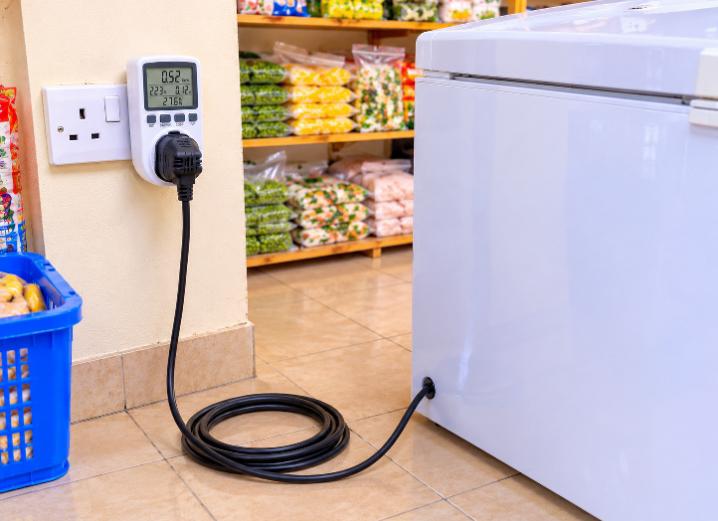 A plug-in energy meter shows the real kWh your freezer uses over a day.
Once you have the daily kWh, enter it in the optional box of my deep freezer electricity cost calculator. It then skips the guesswork on duty cycle.
My rule: a measured number beats a calculated one every time.
Case study: a shop with two freezers
This case study is illustrative. The seller, whom I will call Tunde, and all the numbers are invented to show the method.
Tunde runs a small frozen food shop with two chest freezers. He pays for power every month and thinks the bill is fair. But he has never measured anything.
He buys an energy meter and logs each freezer for seven days. Freezer A averages 2.0 kWh a day. Freezer B averages 1.4 kWh a day.
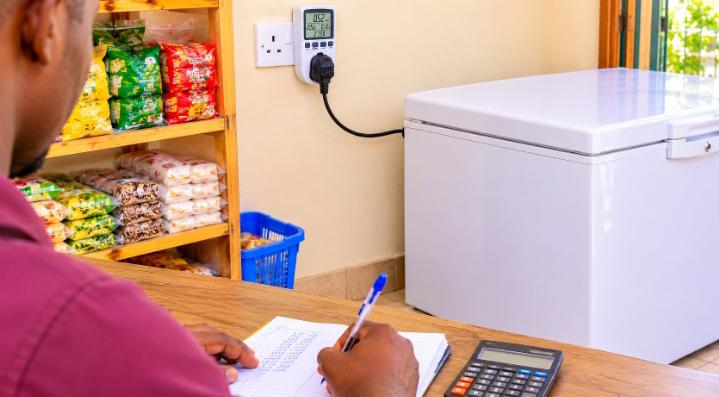 Writing down readings for a week gives you a number you can compare later.
Next he changes four things. He pulls both freezers about 15 cm from the wall, moves one out of the afternoon sun, defrosts the frosty one, and cleans the dusty coils.
He measures again for a week. The table shows his results at an example tariff of ₦150 per kWh.
| Freezer A | Freezer B | Total | |
|---|---|---|---|
| Daily kWh before | 2.0 | 1.4 | 3.4 |
| Monthly cost before | ₦9,000 | ₦6,300 | ₦15,300 |
| Daily kWh after | 1.7 | 1.2 | 2.9 |
| Monthly cost after | ₦7,650 | ₦5,400 | ₦13,050 |
In this made-up example Tunde saves ₦2,250 a month, which is ₦27,000 a year. He paid nothing for the changes except a little time.
Your result will be different. It may be smaller or larger, and I cannot promise a fixed saving. The lesson is to measure first, change one thing at a time, then measure again.
Grid, generator or solar: how they compare
Your power source changes the cost per unit more than almost anything else. This table gives a general picture, not exact prices.
| Power source | Cost per unit | Reliability | Upfront cost | Main risk |
|---|---|---|---|---|
| Grid supply | Usually the lowest | Depends on your area | Low | Outages can spoil stock |
| Petrol generator | Often the highest | Works when the grid fails | Medium | Fuel cost, noise, fumes, breakdowns |
| Inverter and battery backup | Low to medium | Good for short outages | Medium to high | Batteries run out in long outages |
| Solar with batteries | No fuel bill after setup | Good if sized correctly | High | Undersized system, battery replacement |
To compare fairly, work out your generator's cost per kWh. Divide the money you spend on fuel in a day by the kWh the generator delivers to your load.
Safety matters here. Never run a generator indoors or near a window. The fumes can kill.
If you plan to add solar or an inverter, use my inverter and battery sizing calculator to get a first estimate.
Eight ways to lower the running cost
You do not need to buy anything new for most of these. Start with the free ones.
1. Give it room to breathe. Leave a gap of about 10 to 15 cm behind and beside the freezer. The motor and coils need air to shed heat.
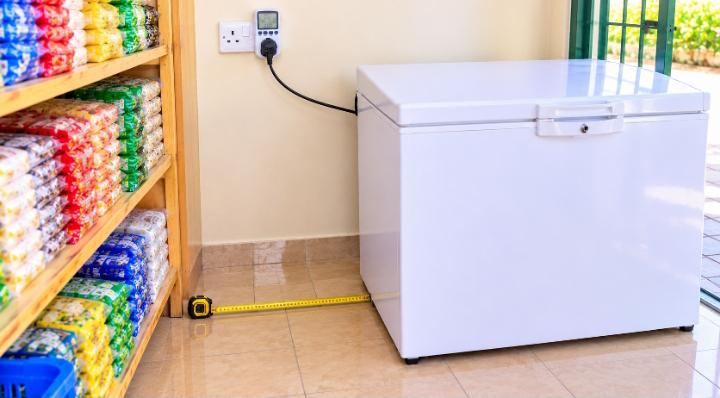 A little space around the freezer lets heat escape and helps the compressor rest.
2. Keep it out of the sun. A freezer in direct sunlight or next to a generator works much harder. Move it to the coolest, most shaded spot you have.
3. Open the lid less. Decide what you need before you lift it. Use one person to fetch items instead of three people opening it in turn.
4. Keep it reasonably full. Empty space lets warm air in quickly. Fill gaps with containers of frozen water, but leave space for air to move.
5. Defrost when ice builds up. Thick frost works like a blanket and makes the compressor run longer. Defrost and wipe it out when ice gets thick.
6. Check the door seal. Close the lid on a strip of paper. If you can pull the paper out easily, the seal may be weak and leaking cold air.
7. Do not set it colder than you need. Frozen food is usually kept at -18°C (0°F) or colder. Going far below that wastes power.
8. Combine half-empty freezers. Two half-full freezers often cost more than one full one. Measure first, then decide if you can merge stock safely.
One thing I would never do is switch the freezer off at night to save money. The savings are small and the food safety risk is large.
Five mistakes I see in cost estimates
Most wrong estimates come from the same few errors. Check yours against this list.
- Multiplying the label watts by 24 hours. This ignores duty cycle and often doubles the answer.
- Using a guessed tariff. Use your own receipt, not a figure you heard.
- Forgetting generator fuel. If you run a generator during outages, add that cost on top.
- Measuring on a cool day only. Hot weather can raise the use. Measure in more than one season if you can.
- Ignoring the condition of the freezer. An old, frosty freezer can use far more than its label suggests.
Quick checklist
Run through this list before you trust any number.
- I copied the watts and kWh figures from the label.
- I worked out my real cost per unit from a receipt.
- I measured with an energy meter for at least one day.
- I added generator fuel for outage days.
- I checked airflow, shade, frost and the door seal.
Questions people ask
How much does a deep freezer cost per month?
It depends on watts, duty cycle and tariff. In my example, a 150-watt freezer at 50% duty and ₦150 per kWh costs about ₦8,100 a month.
Does a full freezer use less power?
A well-stocked freezer usually holds cold better, so the compressor rests more. A packed freezer with blocked airflow can still struggle, so leave space for air to move.
Is it cheaper to run one big freezer or two small ones?
Often one full freezer costs less than two half-empty ones. The only way to be sure is to measure both setups and compare the kWh.
Can I run a deep freezer on an inverter?
Yes, but the compressor needs extra power to start. Size the inverter for that surge, not just the running watts. My sizing calculator includes this.
Should I turn the freezer off when the shop is closed?
I would not. Frozen food needs steady cold. The small saving is not worth the risk of spoiled stock.
Continue reading
If this guide helped, these pages are the best next steps:
- How to Calculate the Profit of a Frozen Food Business shows how power costs fit into your real profit.
- Deep Freezer Electricity Cost Calculator turns your own numbers into a monthly cost.
- Inverter and Battery Sizing Calculator helps you plan backup power.
- More Electricity and Solar guides covers power for small cold-chain businesses.
General information only, not professional advice. See our disclaimer and editorial policy.
Print it, save it as a PDF, or copy the link to find it again.
0 Comments