
How to Calculate the Profit of a Frozen Food Business

- 1Sales, gross profit and operating profit
- 2Step 1: List every cost
- 3Step 2: Find your true cost per carton
- 4Step 3: Markup and margin are different things
- 5Step 4: Count spoilage and unsold stock
- 6Step 5: Decide how much to buy
- 7A worked example for one batch
- 8Break-even: how many cartons you must sell
- 9How you sell changes your profit
- 10Case study: one month at a small shop
- 11Keep simple weekly records
- 12Seven habits that protect your profit
- 13Five mistakes to avoid
- 14Quick checklist
- 15Questions people ask
- How do I calculate profit on one carton?
- What is a good profit margin?
- Should I count unsold stock as profit?
- How often should I check my numbers?
- Does power cost really matter?
- 16Continue reading
- Money coming in is not profit
- Separate gross profit from operating profit and count spoilage as a cost
- Know your true cost per carton before you set a price
- Break-even tells you how many cartons you must sell to cover costs
- Keep simple weekly records so problems show early
Selling a lot of frozen food feels like winning. The freezer is full, customers keep coming, and money keeps moving. Yet many sellers reach the end of the month and wonder where the profit went.
The reason is usually simple. Money coming in is not profit. Profit is what remains after you pay for stock, transport, power, rent, wages and the stock that spoils.
In this guide I show the method I would use to find the real number. I include a case study, comparison tables and a break-even example. The figures are made up, so use your own.
Sales, gross profit and operating profit
People use these words loosely, and that causes mistakes. Here is how I separate them.
| Term | What it means | Simple formula |
|---|---|---|
| Revenue | All the money from sales | Cartons sold × selling price |
| Gross profit | What is left after paying for the stock you sold | Revenue − cost of stock sold |
| Operating profit | What is left after running costs and losses | Gross profit − running costs − spoilage |
I stop at operating profit in this guide. Tax and loan interest depend on your situation, so ask an accountant about those.
One more point matters. Only count the stock you actually sold. Cartons still sitting in the freezer are stored money, not profit.
Step 1: List every cost
Most sellers remember the price of the stock. Fewer remember the small costs around it. Those small costs are where profit leaks away.
Write down every cost you pay in a month. This table shows the usual ones.
| Cost | Examples | Behaviour |
|---|---|---|
| Stock | Price paid per carton | Rises and falls with sales |
| Transport | Bringing cartons in, delivery | Rises and falls with sales |
| Power | Grid units, generator fuel | Mostly steady each month |
| Rent | Shop or stall fee | Fixed |
| Wages | Helpers, delivery person | Mostly fixed |
| Packaging | Bags, labels, ice | Rises and falls with sales |
| Phone and fees | Data, POS and transfer charges | Mixed |
| Spoilage | Stock you throw away | Rises and falls with care |
I treat power as a monthly cost. If you are not sure what your freezer costs, read my guide on how much it costs to run a deep freezer.
Step 2: Find your true cost per carton
The price on the supplier's invoice is not your real cost. Add the costs of getting the carton to your freezer. I call this the landed cost.
Landed cost = (purchase price + transport + offloading) ÷ cartons.
Here is an example. You buy 10 cartons at ₦40,000 each, which is ₦400,000. Transport costs ₦10,000 and offloading costs ₦2,000.
The total is ₦412,000. Divide by 10 and your landed cost is ₦41,200 per carton. If you sell at ₦48,000, your profit is ₦6,800, not ₦8,000.
 Count the cartons and note every cost the moment stock arrives.
That gap of ₦1,200 looks small. Over 60 cartons a month it is ₦72,000. Small gaps are how profit disappears without a sound.
Step 3: Markup and margin are different things
These two words get mixed up all the time. They use the same profit figure but divide it by different numbers.
- Markup = profit ÷ cost. It tells you how much you added on top of what you paid.
- Margin = profit ÷ selling price. It tells you how much of each sale you keep.
Margin is always the smaller number. I prefer to price by margin, because it shows what you keep from each naira of sales.
This table uses the landed cost of ₦41,200 from the last step.
| Selling price | Profit per carton | Markup | Margin |
|---|---|---|---|
| ₦45,000 | ₦3,800 | 9.2% | 8.4% |
| ₦48,000 | ₦6,800 | 16.5% | 14.2% |
| ₦50,000 | ₦8,800 | 21.4% | 17.6% |
| ₦52,000 | ₦10,800 | 26.2% | 20.8% |
Look at the first row. At ₦45,000 you keep about 8 kobo from each naira of sales, and your other costs still need paying.
Before you raise a price, check what other sellers near you charge. A higher price that sends customers away can cost more than it earns.
Here is how I would test a new price. Change one product only and keep the old price on the rest. Watch sales for two weeks.
If sales hold and your margin rises, roll the new price out slowly to the other products.
Step 4: Count spoilage and unsold stock
Spoilage is a real cost. You paid for the stock, and it earns nothing. The loss comes straight off your profit.
Track it with a simple rate: cartons lost ÷ cartons bought. If you buy 60 cartons and lose 3, your spoilage rate is 5%.
Unsold stock is different. It is not a loss yet, but your money is stuck in it. Slow sellers can turn into spoilage if they sit too long.
The best habit I know is first in, first out. Sell the oldest stock first. Mark each carton with the date it arrived and place newer cartons behind older ones.
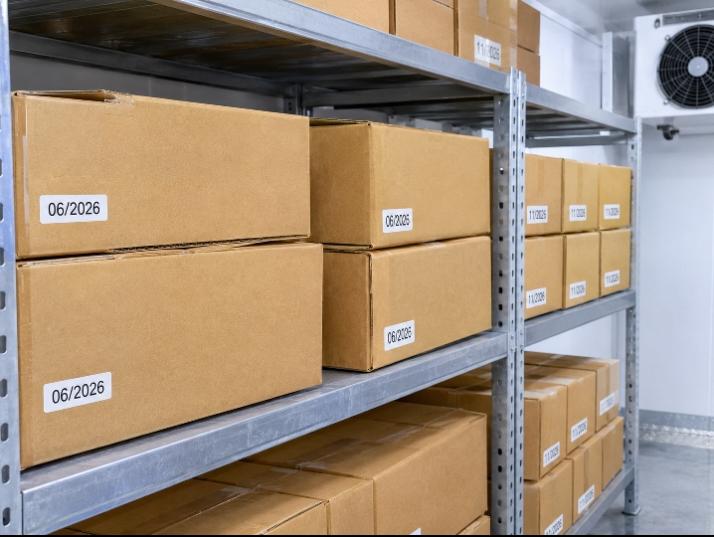 Label each carton with its arrival date and sell the oldest first.
Step 5: Decide how much to buy
Buying too much is a quiet way to lose money. Stock that sits for weeks gets old, takes space and risks spoilage.
Start with your average weekly sales. If you sell about 13 cartons a week, buying 40 at once gives you three weeks of stock.
Now compare that with the saving. Say a supplier gives ₦500 off each carton for a bulk order. On 40 cartons, that saves ₦20,000.
Losing a single carton costs ₦40,000. That wipes out the whole discount twice over. A bulk deal only works if you sell the stock fresh.
Here is the rule I like. Buy enough to cover the days until your next supply trip, plus a small safety stock. Then adjust after each month's records.
Also keep a reorder point. When you are down to about three days of stock, order again. This avoids both empty shelves and overfilled freezers.
A worked example for one batch
Let me put it all together with a small batch. I ignore offloading to keep the numbers easy.
- Buy 10 cartons at ₦40,000: ₦400,000
- Sell 9 cartons at ₦48,000: ₦432,000
- Cost of the 9 cartons sold: ₦360,000
- Gross profit: ₦72,000
- Running costs (transport ₦10,000 and power ₦15,000): ₦25,000
- One carton spoiled, costing ₦40,000
- Operating profit: ₦72,000 − ₦25,000 − ₦40,000 = ₦7,000
That is a margin of about 1.6%. The batch looked like a ₦72,000 win, but it left only ₦7,000. One lost carton did most of the damage.
Break-even: how many cartons you must sell
Break-even is the point where you stop losing money. Sell fewer cartons and you lose. Sell more and you profit.
The formula is simple: (running costs + spoilage) ÷ profit per carton.
For the batch above, costs plus spoilage come to ₦65,000. Profit per carton is ₦8,000. So ₦65,000 ÷ ₦8,000 is about 8.1 cartons.
In real life you cannot sell part of a carton, so round up to 9 cartons. Sell 9 or more and the batch makes money.
You can test your own numbers in my frozen food profit calculator. It shows break-even, margin and unsold stock value as you type.
How you sell changes your profit
Selling whole cartons and selling single packs are two different businesses. This table compares three common ways.
| Approach | Profit per carton | Speed | Workload | Spoilage risk |
|---|---|---|---|---|
| Whole cartons to buyers | Lower | Fast | Low | Low |
| Single packs or pieces | Higher | Slower | High | Medium to high |
| A mix of both | In between | Medium | Medium | Medium |
Retail gives a better price per carton, but you open the freezer more and handle the stock more. That means more power use and more chances for spoilage.
I would start with a mix. Sell some cartons fast to keep cash moving, and sell packs for the extra margin. Then track which part earns more.
Case study: one month at a small shop
This case study is illustrative. The seller, whom I will call Ngozi, and all numbers are invented to show the method.
Ngozi runs a small frozen food shop. At month end she sees a full till and feels happy. Then she writes every figure in a notebook.
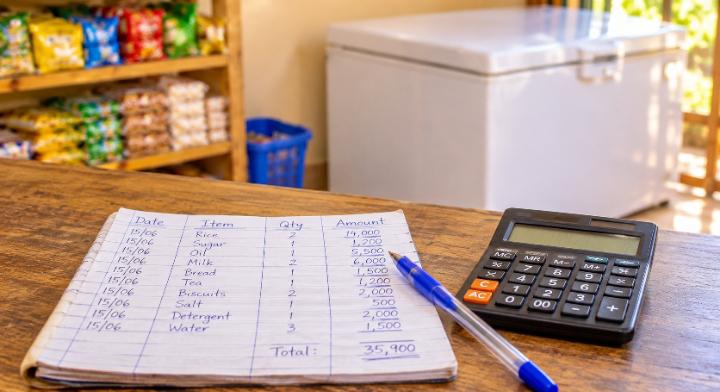 Writing every figure down shows what the till alone cannot.
She bought 60 cartons at ₦40,000. She sold 54 at ₦48,000, lost 3 to spoilage, and still has 3 in the freezer. Here is her month.
| Item | Amount |
|---|---|
| Revenue (54 cartons × ₦48,000) | ₦2,592,000 |
| Cost of cartons sold (54 × ₦40,000) | ₦2,160,000 |
| Gross profit | ₦432,000 |
| Transport | ₦60,000 |
| Power | ₦90,000 |
| Rent | ₦50,000 |
| Wages | ₦100,000 |
| Packaging | ₦20,000 |
| Phone and fees | ₦10,000 |
| Running costs total | ₦330,000 |
| Spoilage (3 cartons × ₦40,000) | ₦120,000 |
| Operating profit | −₦18,000 |
Ngozi sold 54 cartons and still lost money. The ₦432,000 gross profit looked healthy, but costs and spoilage took more than all of it.
Her three unsold cartons are worth ₦120,000 at cost. That money is stuck in the freezer, not lost, but it is not in her pocket either.
Now check her break-even. Costs plus spoilage are ₦450,000. Profit per carton is ₦8,000. That is 56.25, so she needed 57 cartons. She sold 54.
She tries two fixes. The table shows each one, assuming the same 54 cartons sell.
| Change | Effect | New operating profit |
|---|---|---|
| Cut spoilage from 3 cartons to 1 | Saves ₦80,000 | ₦62,000 |
| Raise the price by ₦1,000 per carton | Adds ₦54,000 | ₦36,000 |
| Do both | Adds ₦134,000 | ₦116,000 |
Fewer spoiled cartons beat the price rise, and it costs her no customers. A price rise may also slow sales, so Ngozi tests it on one product first.
The lesson is plain. Without a written record, Ngozi would have thought the month was good. The numbers told her the truth.
Keep simple weekly records
You do not need software. A school exercise book works fine. What matters is that you write the same things every week.
Use one row per week with these columns:
| Week | Cartons in | Cartons sold | Spoiled | Cartons left | Money in | Costs paid |
|---|---|---|---|---|---|---|
| 1 | 15 | 13 | 1 | 1 |
At the end of the month, add the columns and run the formulas from this guide. It takes about twenty minutes.
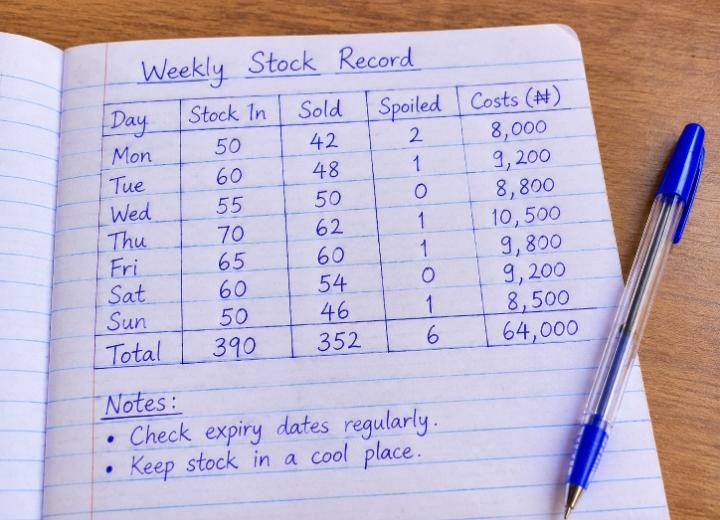 A plain weekly sheet is enough to spot problems before they grow.
Seven habits that protect your profit
These habits cost nothing. They come from the same numbers you already track.
- Price from landed cost. Never price from the invoice alone.
- Sell oldest stock first. Use dates on every carton.
- Record every loss. A spoiled carton noted today teaches you something tomorrow.
- Check your supplier price each time. Prices move, and your margin moves with them.
- Keep business money separate. Mixing it with personal money hides the truth.
- Plan for outages. Know what you will do before the power goes off.
- Review monthly. Run the formulas once a month, on the same day.
Five mistakes to avoid
Most profit problems come from a short list of errors.
- Counting revenue as profit. Revenue is only the starting point.
- Ignoring spoilage. Treat it as a cost, not bad luck.
- Forgetting small costs. Transport, bags and fees add up fast.
- Mixing up markup and margin. Use margin to see what you keep.
- Buying too much at once. Extra stock that cannot sell fast becomes spoilage.
Quick checklist
Check these before you decide your month was good.
- I know my landed cost per carton.
- I counted spoilage as a cost.
- I left unsold stock out of profit.
- I know my break-even in cartons.
- I wrote down this month's numbers.
Questions people ask
How do I calculate profit on one carton?
Subtract the landed cost from the selling price. If a carton costs ₦41,200 to land and sells for ₦48,000, you earn ₦6,800 before other costs.
What is a good profit margin?
It depends on your costs and your market. I cannot give a number that fits every shop. Work out your own break-even first, then aim above it.
Should I count unsold stock as profit?
No. Unsold stock is still inventory. Count profit only on cartons you sold, and note the unsold stock at cost.
How often should I check my numbers?
Record weekly and review monthly. A weekly record shows problems early, and a monthly review shows the whole picture.
Does power cost really matter?
Yes. Freezers run all day, so power is one of the largest running costs. My calculator can turn your meter reading into a monthly figure.
Continue reading
If you want to go deeper, these are the best next steps:
- How Much Does It Cost to Run a Deep Freezer in Nigeria? explains your biggest running cost.
- Frozen Food Profit Calculator works out profit, margin and break-even for you.
- Frozen Food Spoilage Loss Calculator shows what lost stock costs you.
- More Frozen Food Profitability guides covers pricing, stock and margins.
General information only, not professional advice. See our disclaimer and editorial policy.
Print it, save it as a PDF, or copy the link to find it again.
0 Comments