
How Many Watts Does a Deep Freezer Use in Nigeria?

- 1The quick answer
- 2Watts, hours and units in plain words
- 3What watts do deep freezers carry?
- 4Why label watts is not what you use each day
- 5What makes the compressor run longer
- 6Three ways to find your freezer's watts
- 1. Read the rating plate
- 2. Work it out from volts and amps
- 3. Measure it with a plug-in energy meter
- 7Turn watts into units and naira
- 8Imagine two freezers with the same label
- 9What your watts mean for a generator or inverter
- 10Seven ways to bring the watts you pay for down
- 11Mistakes people make with freezer watts
- 12Quick checklist
- 13Questions people ask
- How many watts does a 200-litre deep freezer use?
- Does a deep freezer use 24 hours of power a day?
- How many watts do I need for an inverter to run a deep freezer?
- Is a bigger freezer always more expensive to run?
- What is the difference between watts and kWh?
- 14Continue reading
- Most deep freezers show a rating between about 80 and 300 watts, and that figure is the maximum, not the daily average
- Real daily use depends on how long the compressor runs
- Multiplying label watts by 24 hours can double your estimate
- A plug-in energy meter gives you the true number in one day
There is a sound every freezer owner knows. The compressor hums, clicks off, and the shop goes quiet. Then the worry arrives: what is this box costing me?
You want a number. Maybe a friend said a freezer uses about 200 watts, and your bill does not match.
Maybe you are about to buy an inverter and you are scared of picking the wrong size.
In this guide I give you the number, then show you why it can fool you. By the end you will know your own freezer's watts and what they cost in naira.
The quick answer
Most deep freezers carry a rating somewhere between about 80 and 300 watts. Small chest freezers sit near the bottom of that range. Large commercial freezers sit near the top.
That figure is the power the freezer draws while the compressor is running. It is the most the freezer asks for, not what it pulls every minute of the day.
The US Department of Energy makes the same point in its guide to estimating appliance energy use. The stamped wattage is the maximum, and daily energy comes from the hours an appliance really runs.
Keep those two ideas together and you avoid the most common mistake. People multiply label watts by 24 hours and end up fearing a bill that never comes.
In one line: label watts tell you how hard the freezer works when it works. Running hours tell you what you pay for.
Watts, hours and units in plain words
A watt measures how fast a freezer uses power. A kilowatt-hour (kWh), the "unit" on your prepaid meter, measures how much power it used over a stretch of time.
Think of a bus. The speed is the watts. The distance covered is the kWh. A bus doing 100 km an hour for one hour covers 100 km.
A freezer drawing 1,000 watts for one hour uses 1 kWh. A 150-watt freezer needs about six and a half hours of running to use the same single unit.
That is why two freezers with different labels can end up costing almost the same. What matters is the watts and the running hours together.
What watts do deep freezers carry?
Sizes differ, brands differ, and age matters. This table gives rough ranges so you know what to expect. Your own rating plate always beats it.
| Freezer type | Rough label range | Why it differs |
|---|---|---|
| About 100 litres | 70 to 110 W | Small cabinet, small compressor |
| About 200 litres | 90 to 160 W | The common shop and home size |
| About 300 litres | 120 to 220 W | More food to cool, more wall area |
| About 500 litres | 180 to 300 W | Needs a stronger compressor |
| Glass-top display freezer | 250 to 500 W | Glass loses more cold, and lights add load |
Why do bigger boxes use more? A larger cabinet holds more food to cool and has more wall area for heat to leak in. It needs a stronger compressor to keep up.
Glass-top display freezers lose more cold than plain chest freezers because the lid is glass. Many also carry lights. Expect a higher label than a plain freezer of the same size.
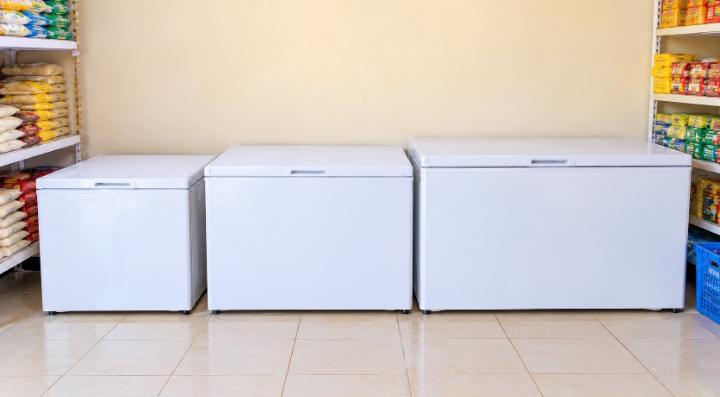 Bigger cabinets usually carry a higher wattage on the rating plate.
If your label sits far outside these ranges, do not panic. First check that you read watts and not amps or kWh. Mixing those up is very common.
Why label watts is not what you use each day
Here is the part that costs people money. A freezer does not run non-stop. The compressor switches on, pulls the temperature down, then rests until the box warms up again.
Over 24 hours the freezer might run for 8, 12 or 16 hours. A hot room, frequent lid openings and thick frost all push that number up.
Take a freezer with a 150-watt label. Multiply 150 by 24 hours and you get 3.6 kWh a day. If the compressor really runs 12 hours, the true figure is 1.8 kWh.
That is exactly half. Over a month the wrong method adds 54 kWh to your estimate. At ₦150 per kWh, that is ₦8,100 of bill that only exists on paper.
Planning around a scary number has a real cost. You hold back on stock, you delay buying a second freezer, and the real bill was never that high.
| Label watts | Monthly cost with 12 running hours | Monthly cost if you wrongly use 24 hours |
|---|---|---|
| 100 W | ₦5,400 | ₦10,800 |
| 150 W | ₦8,100 | ₦16,200 |
| 250 W | ₦13,500 | ₦27,000 |
These figures use ₦150 per kWh and 30 days. Replace the rate with your own and the table changes with it.
What makes the compressor run longer
The watts on the label stay fixed. The running hours move. These are the usual reasons the compressor works overtime, and what you can do about each one.
| Cause | What happens inside | What you can do |
|---|---|---|
| Hot room or direct sun | More heat leaks in, so the compressor runs more | Move the freezer to a cool, shaded spot |
| Frequent lid openings | Warm, damp air enters every time | Plan what you need before you open it |
| Thick frost | Ice slows the movement of cold through the walls | Defrost and wipe it out |
| Weak lid seal | Cold air leaks out all day | Test the seal and replace it if it is loose |
| Blocked airflow | Heat from the coils cannot escape | Leave a gap behind and beside the freezer |
| Warm stock loaded in | The freezer must cool the new food first | Load fresh stock in small batches |
Think of a car. The engine size never changes. A heavy foot and a long drive burn more fuel. Your freezer works the same way.
These habits sound small. Picture a shop that opens the lid fifty times a day and leaves it ajar while serving customers. That compressor is working overtime.
Fix two or three of these and the compressor can rest for longer each day. You will see it as fewer units on your meter at month end.
The label sets the size of the engine. Your habits decide how long you leave it running.
Three ways to find your freezer's watts
You do not need to guess. There are three ways to get the number, and I list them from easiest to most accurate.
1. Read the rating plate
Look at the back, the side or inside near the top edge. You are hunting for a sticker or metal plate with small print.
Copy the line marked W or kW. If it says kW, multiply by 1,000 to get watts. If the print is hard to read, my freezer power rating decoder explains each figure.
2. Work it out from volts and amps
Some plates show volts and amps but no watts. Multiplying them gives apparent power in VA, not guaranteed watts, because of something called power factor.
So treat the answer as a close estimate, not a fact. The decoder above shows both the VA figure and an estimate when you add a power factor.
3. Measure it with a plug-in energy meter
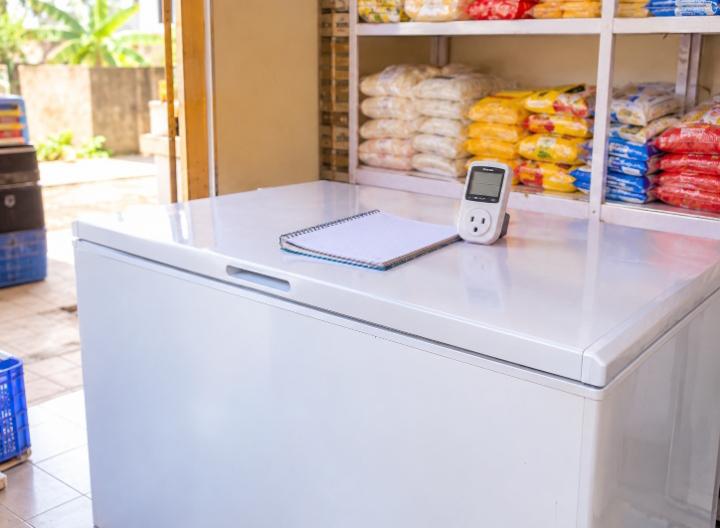
This is the honest method. Plug the meter into the wall socket and the freezer into the meter. Leave it for 24 hours with normal use.
Read the kWh on the screen. That one number already includes the compressor cycling, your room heat and your lid openings. Nothing beats it.
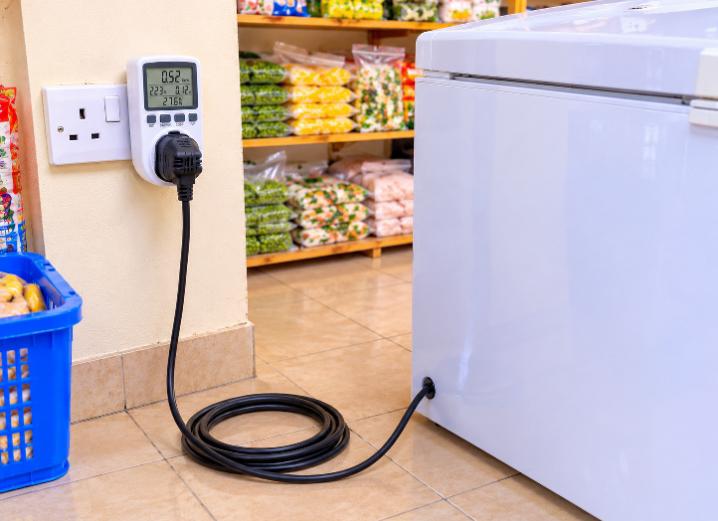 A day on a plug-in meter tells you more than any label.
If you are not sure the meter can handle your freezer's current, ask an electrician first. Never open the back of the freezer or touch its wiring yourself.
Turn watts into units and naira
Now you can do the maths. It takes three short steps.
- Daily kWh = watts × running hours ÷ 1,000
- Monthly kWh = daily kWh × number of days
- Monthly cost = monthly kWh × your rate per kWh
Your rate is easy to find. Take your last token receipt and divide the naira you paid by the units you received. That is what you really pay.
The regulator, the Nigerian Electricity Regulatory Commission, publishes tariff information on its website. Your own receipt still tells you the figure that matters for your shop.
Do not want to do the sums by hand? Type your numbers into my deep freezer wattage and electricity consumption calculator. It gives daily and monthly kWh and your naira cost.
Imagine two freezers with the same label
Say a seller named Chidi owns two 150-watt freezers. One is new. The other is eight years old, thick with frost, and the lid seal is tired.
Chidi expects the same cost from both. Then the bill comes, and it is higher than he planned. That small sting is how most owners find out something is off.
He buys a plug-in meter and tracks each freezer for a week. The new one averages 1.7 kWh a day. The old one averages 2.6 kWh a day.
| New freezer | Old freezer | |
|---|---|---|
| Label watts | 150 W | 150 W |
| Measured daily kWh | 1.7 | 2.6 |
| Monthly kWh | 51 | 78 |
| Monthly cost at ₦150 per kWh | ₦7,650 | ₦11,700 |
Same label, very different bills. The old freezer costs ₦4,050 more every month. The label never warned him.
Chidi defrosts the old freezer, cleans the coils and replaces the seal. A week later it averages 2.0 kWh a day, or ₦9,000 a month. Your result will differ, but the lesson stays the same.
The label tells you what a freezer can draw. Only a meter tells you what your freezer, in your shop, actually costs.
What your watts mean for a generator or inverter
Watts also decide what backup power you need. But there is a second number people forget: the surge when the compressor starts.
A compressor can pull several times its running watts for a moment as it switches on. An inverter sized only for the label may trip. My freezer startup surge calculator checks that for you.
For batteries and inverter size, use the inverter and battery sizing calculator. It adds battery depth of discharge and inverter losses to the sum.
If you run a generator, the real question is cost per unit. Fuel bills hide it. The generator cost per kWh calculator turns your fuel records into an hourly and per-kWh cost.
Seven ways to bring the watts you pay for down
You cannot change the label. You can change how long the compressor runs, and that is where the money is.
- Give it airflow. Leave a gap of about 10 to 15 cm behind and beside the freezer so heat can escape.
- Keep it out of the sun. A hot corner makes the compressor run longer.
- Open the lid less. Decide what you need before you lift it.
- Defrost thick ice. Frost makes the compressor work harder for the same cold.
- Check the seal. Close the lid on a strip of paper. If it slides out easily, cold air is leaking.
- Keep it reasonably stocked. A mostly empty box warms quickly when the lid opens.
- Never switch it off at night to save money. Food safety agencies such as the USDA advise keeping frozen food at or below 0°F (-18°C) and the door shut during an outage.
Mistakes people make with freezer watts
Most wrong estimates come from the same short list. Check yours against it.
- Multiplying label watts by 24 hours. This assumes the compressor never rests.
- Mixing up watts, amps and kWh on the plate. Read the unit printed after each number.
- Using a rate you heard from someone else. Use your own receipt.
- Forgetting the startup surge. It matters when you add an inverter.
- Trusting the label over a meter. A meter reading wins every time.
Quick checklist
Run through this before you trust any watt figure.
- I found the rating plate and copied the watts.
- I know my real cost per unit from a receipt.
- I used compressor running hours, not 24 hours.
- I measured one freezer with an energy meter.
- I checked startup surge before choosing an inverter.
Questions people ask
How many watts does a 200-litre deep freezer use?
Many labels fall between about 90 and 160 watts. Read yours, because brands and ages differ. Real daily use depends on how long the compressor runs.
Does a deep freezer use 24 hours of power a day?
It is plugged in 24 hours, but the compressor only runs part of that time. Hot rooms and lid openings make it run longer.
How many watts do I need for an inverter to run a deep freezer?
The inverter must cover the startup surge, not just the running watts. Check both in the surge calculator before you buy.
Is a bigger freezer always more expensive to run?
Usually, but not always. An old, frosty small freezer can cost more than a newer large one. Measure before you decide.
What is the difference between watts and kWh?
Watts show how fast power is used. A kWh is the amount used over time. Your bill counts kWh.
Continue reading
If this helped, these pages are good next steps:
- How Much Does It Cost to Run a Deep Freezer in Nigeria? walks through your monthly cost step by step.
- How Much Does It Cost to Run Two Deep Freezers in Nigeria? covers shops with more than one box.
- Deep Freezer Electricity Cost Calculator uses a duty-cycle percentage instead of running hours.
- How to Calculate the Profit of a Frozen Food Business shows where power costs fit in your real profit.
General information only, not professional advice. See our disclaimer and editorial policy.
Print it, save it as a PDF, or copy the link to find it again.
0 Comments