
How to Check the Power Rating of a Deep Freezer

- 1The quick answer
- 2Where to find the rating plate
- 3What each figure on the plate means
- 4The volts times amps trap
- 5A plate read line by line
- 6Do not mix up kW, kWh and kVA
- 7Why this one number matters
- 8Rated power versus measured power
- 9What to do when the plate is missing or unreadable
- 10Imagine buying a second-hand freezer
- 11What to do with the number once you have it
- 12Stay safe while you check
- 13Mistakes people make when they read a plate
- 14Quick checklist
- 15Questions people ask
- Where is the power rating on a deep freezer?
- Is volts times amps the same as watts?
- What if the rating plate has no watts?
- How many watts does a 300-litre freezer use?
- Can I check the power rating without unplugging the freezer?
- 16Continue reading
- The rating plate is usually at the back, on the side or inside near the top edge
- Copy the number next to W or kW, and check the unit printed after it
- Volts times amps gives VA, which is not always the same as watts
- A plug-in energy meter shows what your freezer really uses
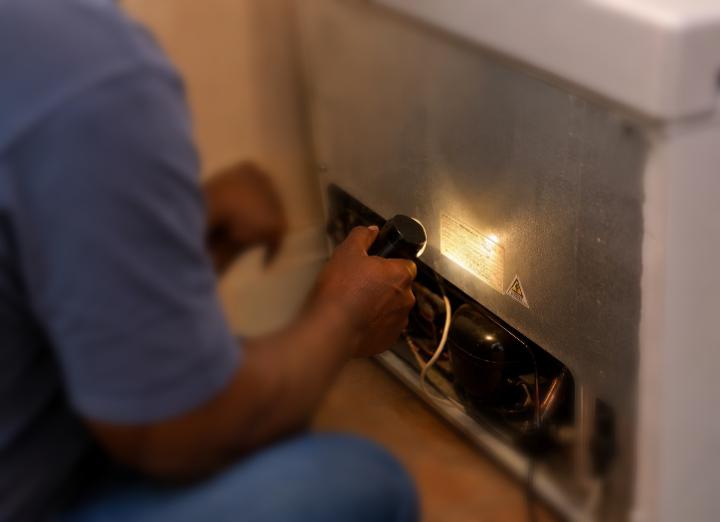
You crouch behind the freezer with a phone torch in your hand. The back is dusty. The plate is half scratched, and the print is tiny.
You only want one answer: how much power does this freezer need? Maybe you are sizing an inverter. Maybe you are buying a used unit. Maybe the last bill gave you a shock.
In this guide I show you where the rating plate hides, how to read it line by line, and what to do when the plate is gone.
I also show you the volts-times-amps trap that catches many people.
The quick answer
The power rating lives on a sticker or metal plate on the freezer. You will usually find it at the back, on the side, or inside near the top edge.
It lists volts, amps, hertz and often watts.
Copy the number next to W or kW. If you only see volts and amps, multiply them to get VA, then remember that VA is not always the same as watts.
If there is no plate at all, check the manual, look up the model number on the brand's website, or measure the freezer with a plug-in energy meter.
Here is the short routine I follow:
- Unplug the freezer and keep the lid shut.
- Pull it gently away from the wall.
- Light the plate with a torch and take a clear photo.
- Copy the volts, amps, hertz, watts and any kWh figure.
- Put the numbers into a power rating decoder to see what they mean.
Where to find the rating plate
Brands put the plate in different places. This table shows where I would look first.
| Place | What to look for | Tip |
|---|---|---|
| Back panel | A metal or paper plate near the power cable | Unplug first, then pull the freezer out gently |
| Outside side wall | A sticker low down near the back | Wipe off dust with a dry cloth |
| Inside near the top edge | A small label under the lid rim | Check here if the back has no plate |
| Manual or box | A printed specification list | Keep the manual somewhere safe |
If you can read the plate easily, take a photo anyway. A photo saves you from crawling behind the freezer the next time someone asks for the model.
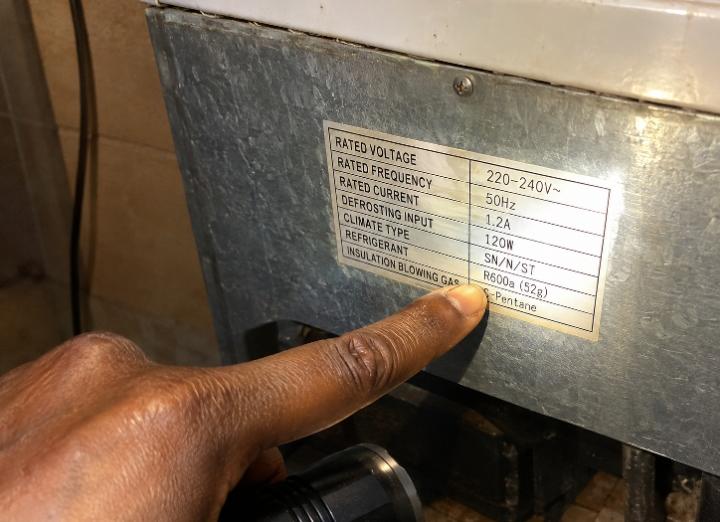 Look for a sticker or metal plate with volts, amps and watts.
Safety comes first here. Unplug the freezer before you move it. Never remove a back panel or touch any wiring.
What each figure on the plate means
A rating plate is a small table of facts. Each line tells you something different, and some lines tell you less than you think.
| Figure | What it tells you | What it does not tell you |
|---|---|---|
| V (volts) | The supply voltage the freezer is built for | How much power it uses |
| A (amps) | The current drawn while running | The average current over a day |
| Hz (hertz) | The supply frequency the freezer expects | Anything about cost |
| W or kW | Power while the compressor runs | What the freezer uses across 24 hours |
| kWh per 24 h or per year | Energy measured in a test room | Your real bill in a hot shop |
| Climate class | The room temperature range it is designed for | How much power it draws |
| Freezing capacity (kg per 24 h) | How much fresh food it can freeze in a day | The running cost |
Look at the W line closely. It shows power while the compressor runs. The freezer rests between cycles, so it does not draw that much all day.
The kWh line is a test result. A shop with a hot room, frequent lid openings and a thick layer of frost will usually use more.
Check the voltage too. A freezer built for your supply voltage runs as intended. If the plate says something very different from your mains, ask a dealer before plugging it in.
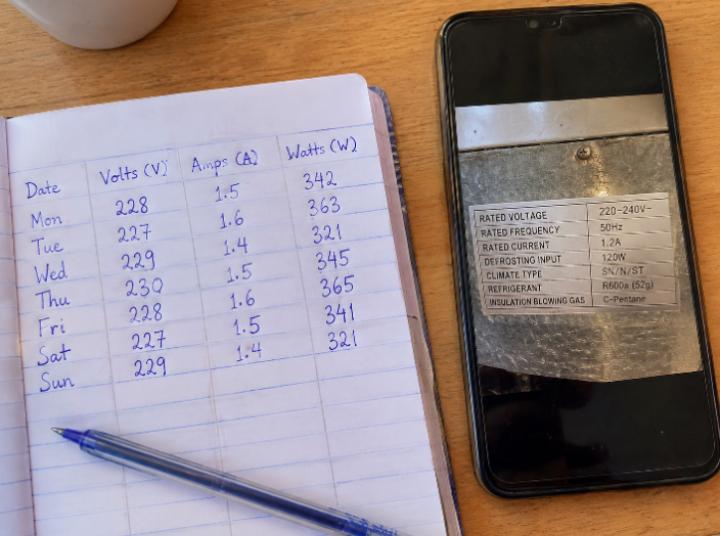 Copy every figure into one place, including the unit that follows it.
The volts times amps trap
Many people multiply volts by amps and call the answer watts. It feels right, and sometimes it comes close. But it is not always true.
Volts times amps gives apparent power in volt-amperes (VA).
Real power in watts also depends on a number called power factor, which sits between 0 and 1. Wikipedia has a plain explanation of power factor if you want the detail.
Take a plate with 230 V and 0.65 A. Multiply them and you get 149.5 VA. That is apparent power.
If the manual gives a power factor of 0.8, the estimate is about 120 W. The two answers are 30 units apart. That gap matters when you size an inverter.
| What you have | What you can say | Example |
|---|---|---|
| Watts printed on the plate | Use them as printed | 120 W shown on the plate |
| Volts, amps and power factor | Estimate the watts | 230 × 0.65 × 0.8 = about 120 W |
| Volts and amps only | State apparent power in VA | 230 × 0.65 = 149.5 VA |
I would never write 149.5 VA as 150 watts in a plan or a purchase decision. My decoder keeps the two apart for you, so you do not mix them up by accident.
A plate read line by line
Let me walk through a plate the way I would read it. Say it shows these lines: 230 V, 50 Hz, 0.65 A, 120 W, 1.1 kWh per 24 h and class ST.
The 230 V and 50 Hz lines tell you the freezer matches a typical household supply. If the voltage on the plate is far from your mains, stop and ask a dealer.
The 0.65 A line is the current while the compressor runs. Multiply it by the voltage and you get 149.5 VA, as shown above. That is higher than the printed 120 W, which is normal.
The 120 W line is the one I trust for running power. It is printed, so I use it as printed and do not recalculate it.
The 1.1 kWh per 24 h line is a test result. Over 30 days that is 33 kWh in a test room.
A hot shop with a busy lid will usually use more, so treat it as a starting point.
The ST line is the climate class. It tells you the room temperatures the freezer is built to handle.
T means tropical and covers the hottest rooms, up to about 43°C. ST covers up to about 38°C.
Shops can get very hot. A freezer built for a cooler room has to work harder in a hot one, and that means longer running hours.
Do not mix up kW, kWh and kVA
Three similar-looking units cause most of the confusion on plates, receipts and price lists.
- kW is power at one moment. 0.12 kW is the same as 120 W.
- kWh is energy over time. It is what your meter counts and what your bill charges for.
- kVA is apparent power. Inverters and generators are often sold in kVA.
If a seller quotes kVA, ask for the watts figure. That is the real power the unit can deliver, and the datasheet shows the exact conversion.
Why this one number matters
It looks like a small detail. But the rating plate feeds almost every decision you make about a freezer.
It decides how big an inverter you need. It shapes your generator fuel bill. It helps you compare two freezers before you spend any money.
It also protects you from advice that sounds sure but is only a guess. When someone says freezers use about 200 watts, you can check your own plate and know.
That is worth two minutes with a torch.
Rated power versus measured power
The watts on the plate show the most the freezer draws. The US Department of Energy explains how to estimate appliance energy use and lists plug-in usage monitors as one way to measure it.
A plug-in energy meter is the simplest tool. Plug it into the wall, plug the freezer into it, and leave it for 24 hours. The kWh figure already includes cycling and your own habits.
Before you buy one, check that it suits your supply voltage and the freezer's current. If you are unsure, ask an electrician. Do not guess with mains power.
Once you know your watts, you can turn them into units and naira. My deep freezer wattage calculator does that, and it lets you enter a measured kWh figure to override the estimate.
What to do when the plate is missing or unreadable
Paint, rust, dust and old age can wipe out a plate. Do not guess from the litre size. Two freezers of the same size can have very different ratings.
Try these steps in order:
- Look for a model number anywhere on the cabinet, the lid or the box.
- Search the model number on the brand's website and find the manual.
- Ask the dealer to check the model against their records.
- Measure the freezer with a plug-in energy meter.
- Ask a qualified electrician to read the current safely.
If none of these works, treat the freezer as an unknown and measure it before you plan an inverter or a generator around it.
Imagine buying a second-hand freezer
Say a seller named Ngozi finds a used 300-litre freezer at a price that feels too good to miss.
The plate is faded. The dealer waves a hand and says the freezer is fine and the plate does not matter.
She feels two things at once. She wants the bargain, and she fears the bill that might follow. That feeling is exactly why you should measure.
She asks to plug the freezer into a meter at the shop. The reading shows about 190 W while the compressor runs. She had assumed 150 W.
| What she assumed | What the meter showed | |
|---|---|---|
| Running watts | 150 W | 190 W |
| Daily kWh at 12 running hours | 1.8 | 2.28 |
| Monthly cost at ₦150 per kWh | ₦8,100 | ₦10,260 |
The difference is ₦2,160 every month. Over a year it adds up to ₦25,920. She can now bargain, or walk away, with real numbers in her hand.
That is the value of checking. You stop buying a story and start buying a freezer.
What to do with the number once you have it
A power rating is only the start. Here is where I would use it next.
If you plan backup power, check the compressor's startup demand. My freezer startup surge calculator compares the starting load with your inverter's limits.
For batteries, use the inverter and battery sizing calculator. It adds depth of discharge, inverter losses and a margin for heat and ageing.
And if you ever have to run the freezer on a generator, the running watts are the first number you need to size it. Write them down where you can find them.
Stay safe while you check
A freezer is heavy and it is plugged into mains power. A few simple rules keep you safe and keep your food cold.
- Unplug before you move it. Never pull a live freezer across the floor.
- Keep the lid shut. The USDA advises keeping freezer doors closed to hold the cold.
- Work quickly. Read the plate, take the photo, then plug the freezer back in.
- Leave the covers on. Do not remove back panels or touch wiring.
- Call an electrician for current readings. Measuring live current is not a job for guesswork.
Mistakes people make when they read a plate
These errors turn a simple check into a costly one.
- Reading amps as watts. Always read the unit printed after each number.
- Treating VA as watts. Apparent power is not the same as real power.
- Trusting the label for daily use. The label shows the maximum, not the average.
- Guessing from litres. Two freezers of the same size can carry different ratings.
- Skipping the photo. A photo saves time when you shop for an inverter later.
Quick checklist
Check these before you trust a rating.
- I found the plate and took a clear photo.
- I copied volts, amps, hertz, watts and any kWh figure.
- I know whether my watts are printed or estimated.
- I did not treat VA as watts.
- I measured the freezer with a meter if the plate was missing.
Questions people ask
Where is the power rating on a deep freezer?
Usually on a plate at the back, on the side or inside near the top edge. Check the manual or the box if you cannot see it.
Is volts times amps the same as watts?
Not always. It gives apparent power in VA. Real watts also depend on the power factor, so treat the product as an estimate.
What if the rating plate has no watts?
Use volts, amps and a power factor from the manual for an estimate. A plug-in meter gives a better answer.
How many watts does a 300-litre freezer use?
Ratings vary by brand and age. Read your own plate or measure it. A table of sizes can only give you a rough feel.
Can I check the power rating without unplugging the freezer?
You can read the plate if you can see it. Unplug before you move the freezer or look behind it.
Continue reading
If this helped, these pages are good next steps:
- How Many Watts Does a Deep Freezer Use in Nigeria? shows how label watts turn into daily use.
- How Much Does It Cost to Run a Deep Freezer in Nigeria? turns your watts into naira.
- Deep Freezer Electricity Cost Calculator gives you a monthly figure in seconds.
- Generator Cost per kWh Calculator shows what backup power really costs.
General information only, not professional advice. See our disclaimer and editorial policy.
Print it, save it as a PDF, or copy the link to find it again.
0 Comments